Tuesday, March 30, 2010

Friday, March 26, 2010
Thursday, March 25, 2010
Class Notes 3/25
Newton's Universe:
- Infinite size
- Infinite number of stars
- Infinite age
- Homogeneous distribution of stars
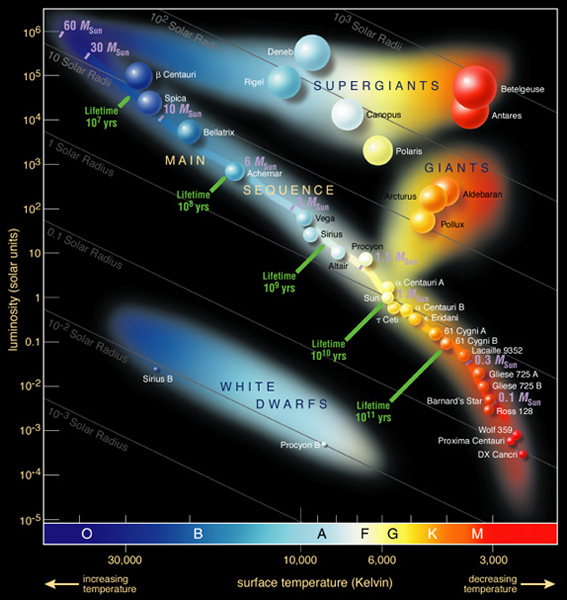
- X-Axis: Temperature in K (Note: increases from right to left)
- Y-Axis: Luminosity in Watts
- Main Sequence: made up of dwarf stars (mostly red dwarfs)
- White Dwarfs: below the main sequence, near the lower left corner of the graph
- Cepheid Variables: near the center of the graph, slightly above the main sequence
Wolfram Alpha
This website is great for Physics:
www.wolframalpha.comIt seems like you can type in basically any physics concept or formula and it will tell you all about it and answer your math questions. It can do some pretty complicated stuff, and it will convert units if you want it to. I think this could be very helpful.
Tuesday, March 23, 2010
Class Notes 3/23
Olber's Paradox
Schwarzchild Radius:
- Newtonian idea of the universe assumes infinite universe and infinite number of stars with homogeneous distribution
- Number of stars of distance d is about d^2
- L = b/(4πd^2)
- Discovered galaxies and the enormous number of them
- The further away a galaxy was the more the Hydrogen spectrum was shifted toward the red.
- v = H0(d) where H0 is called Hubble's constant
- (∆λ) / (λref) = v/c
- The universe is expanding leading to the Big Bang cosmology.
- Ho = 2.2 x 10^4 m/sMly
- From v = H0(d) and d = v(avg)T: T = d/v(avg) = 1/H0
Schwarzchild Radius:
R = (2GM) / (c^2)
Thursday, March 11, 2010
More Astrophysics Notes
What determines the brightness of a star?
- b = L / (4πd2) [W/m2]
What determines the luminosity of a star?
- Assuming a blackbody radiator:
o L = σAT4
o σ = 5.67 x 10⁻⁸ [W/m2K4]
What determines the surface temperature of a star?
- Wein's Law: T = (2.90 x 10⁻³(K·m))/ (λmax)
More massive stars are also more luminous.
Absolute magnitude (M) is the magnitude of a star when observed from 10 parsecs.
Relative magnitude (m) is the magnitude of a star when observed from the Earth (or nearby).
Stars radiate energy through hydrogen fusion.
Fg = GMm/d2
White dwarf- in equilibrium (not a black hole) due to "electron degeneracy"
1 parsec = 3.26 light-years
Astrophysics Notes
How is the Universe Organized?
· The force of gravity clusters matter at an astronomical scale.
· Clusters within the universe
o Solar Systems consist of: one or more stellar bodies, planets, moons, asteroids, comets, dwarf planets (e.g. Pluto, Eris), Kuiper-belt like debris
o Stellar clusters consist of solar systems
o Galaxies
o Galactic clusters consist of galaxies
· Stars and planets are different because stars emit light while planets reflect light.
· A light-year (ly) is the distance light travels in a year.
· 1 ly = (2.998 x 10⁸ m/s) (3.156 x 10⁷ s/yr) = 9.46 x 10¹⁵ m ≈ 1013 km
· Our galaxy is 100,000 ly wide, 2,000 ly tall
· Wein's Law for a blackbody radiator: λmax = (2.90 x 10⁻³) / T (kelvin)
· Gravity bends light
· Andromeda is 2 million ly away
Subscribe to:
Posts (Atom)